Verbal Adjectives and Verbal Conjunctions in the Monuments of the Ancient Turkish Languages
Received: 08-Jan-2024 Accepted: 10-Jan-2024 Published: 22-Oct-2024 Read PDFDownload PDF
Akram JAFAR
DOI:
Abstract
For a long time, some linguists were looking for the origin of the Azerbaijani language in the south, in Ancient Media. It is known that their efforts in this direction did not yield any positive results. Because, almost no connection could be revealed between the Turkic-type Azerbaijani language and the languages known to us of the peoples who lived in the territory of Ancient Media, and the necessary linguistic material that could serve as a basis for scientific research was not found. It turned out that the origin of the Azerbaijani language is connected with the origin of the Turkic-system languages.
The oldest monuments that preserve the history of the Turkic languages, as far as is known to date, are monuments dating back to the fifth century. These monuments can be divided into two parts:
1) linguistic monuments of the Turkic peoples belonging to the period before their adoption of Islam;
2) linguistic monuments belonging to the period after their adoption of Islam.
These two parts of linguistic monuments differ from each other both in terms of the alphabet in which they are written and in terms of language quality (primarily in terms of vocabulary). The monuments of Turkic languages created after Islam was mainly created with the Arabic alphabet and their vocabulary increasingly included elements of the Arab-Persian languages.
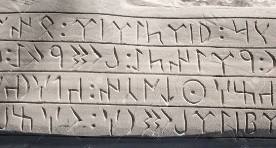
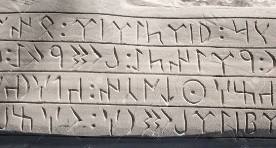
The linguistic monuments of the Turkic peoples belonging to the pre-Islamic period can be divided into three groups: Yenisei monuments, Orkhon monuments, and ancient Uyghur monuments.
The purpose of this work is to examine these three groups of linguistic monuments, to separate and reveal the categories of verbal adjectives and verbal conjunctions in them, and to note their counterparts in the Azerbaijani language. Because in order to understand the substance of the Azerbaijani language, we must study its extinct forms, as well as the modern and extinct forms of related Turkic languages.