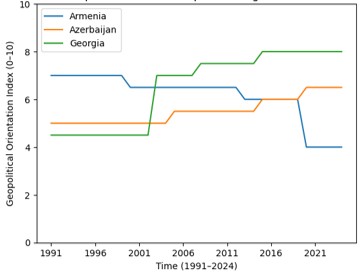
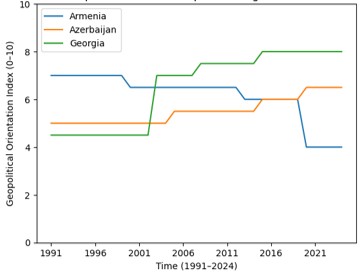
The geopolitics of small states represents one of the most complex analytical domains within contempo-rary international relations theory. While structural realism emphasizes systemic constraints imposed by great powers, small states frequently demonstrate adaptive, nonlinear, and multi-vector behavior that cannot be reduced to material power alone. This article examines the geopolitics of small states through the case of the South Caucasus in the post-Soviet transformation context. It argues that small-state geo-political behavior is shaped by the interaction of six determinants: geography, civilizational identity, his-torical memory, resource potential, external patronage, and internal political culture. The study intro-duces and elaborates the concept of transfer geopolitics to explain asymmetric external representation of national interests, particularly in the Armenian case, and contrasts it with resource-based strategic autonomy (Azerbaijan) and transit-geopolitical positioning (Georgia). The article conceptualizes the South Caucasus as a heterogeneous geopolitical space formed through post-imperial fragmentation, de-layed nation-state consolidation, and ethno-confessional plurality. It concludes that the region represents a unique nonlinear model of small-state geopolitics, where elastic civilizational and historical factors fre-quently override geographical determinism. Small states operate not merely as passive geopolitical ob-jects but as adaptive strategic actors embedded in asymmetrical alliance structures.