Rana Abdinbayova; Fadaya Javadova; Khalil Nagiyev
DOI: https://doi.org/10.30546/209501.201.2026.03.002.238
Abstract
This article examines the role of interactive teaching methods in strengthening student
motivation and academic performance in chemistry. In contrast to lecture-dominated
instruction, interactive chemistry teaching engages learners in experiments, project-based
tasks, collaborative discussions, digital simulations, and multimedia-supported inquiry. The
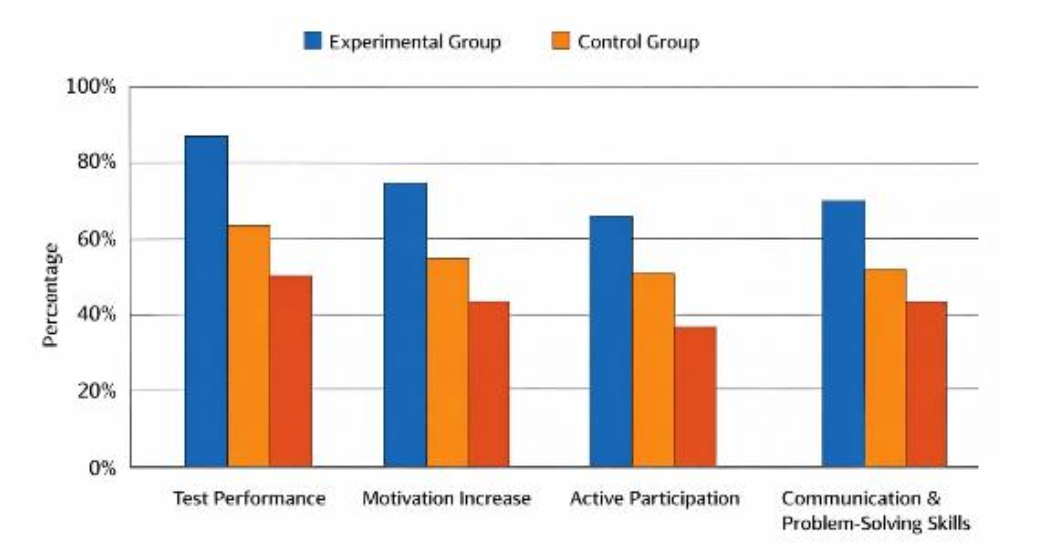
study is based on a year-long classroom intervention involving 60 high school students divided
into control and experimental groups. A pre-test/post-test model, motivation surveys, and
classroom observations were used to evaluate conceptual understanding, participation, and
attitudes toward chemistry. The findings indicate that students exposed to interactive
instruction demonstratedbetter conceptual retention, greater willingness to participate,
stronger peer collaboration, and more positive perceptions of chemistry as a meaningful
school subject. The expanded literature review also shows that active learning, cooperative
learning, peer-led learning, flipped approaches, virtual laboratories, and problem-based
learning can improve chemistry learning outcomes when instruction deliberately connects
symbolic, macroscopic, and microscopic representations. The article argues that motivation
in chemistry increases when students experience autonomy, competence, relevance, and
visible success in classroom tasks. Interactive teaching is therefore not only a methodological
alternative but a pedagogical necessity for making chemistry more understandable, engaging,
and sustainable in the long term.