Fluid Catalytic Cracking (FCC) is one of the principal conversion processes in modern
petroleum refining, enabling the transformation of heavy petroleum fractions into high-octane
gasoline and light olefins. The growing global demand for transportation fuels and low-carbon
chemical feedstocks requires further optimization of both the efficiency and selectivity of FCC
technology. The technological and economic performance of the process is determined
directly by the structural properties of the catalysts used, the nature and distribution of acid
sites, and the architecture of the pore system.
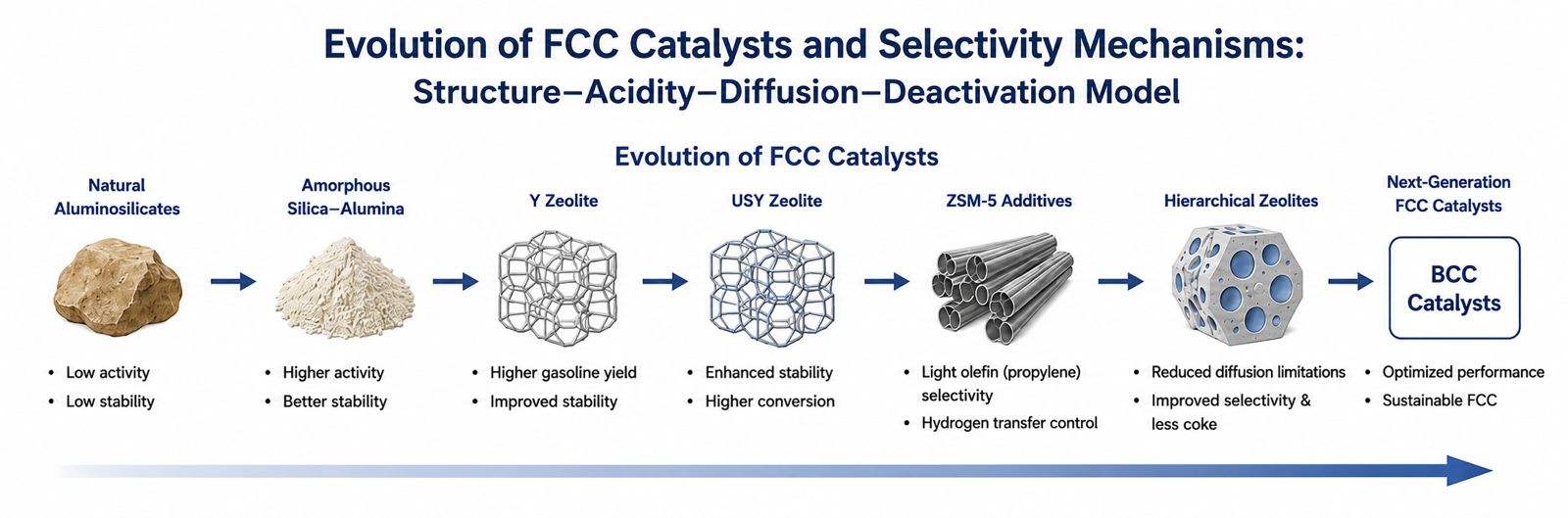
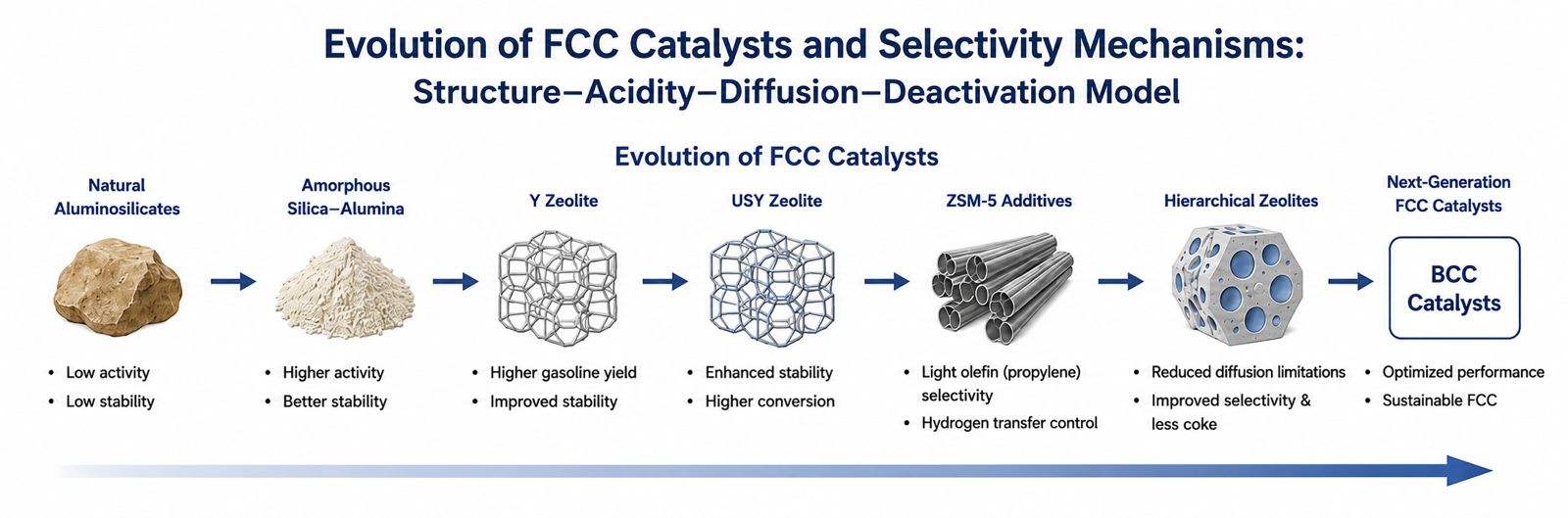
The historical development of FCC catalysts has been characterized by a transition from
natural aluminosilicates to synthetic amorphous systems, and subsequently to zeolite-based
catalysts possessing high stability and shape-selective properties. This evolution has not only
increased catalytic activity but has also enabled the controlled distribution of products and the
optimization of selectivity on a mechanistic basis. In particular, the application of USY and
ZSM-5 type zeolites has played a key role in increasing gasoline yield, selectively producing
light olefins, and controlling hydrogen transfer reactions.
The primary objective of this study is to systematically analyze the evolutionary stages
of FCC catalysts, explain the mechanisms governing selectivity formation within the context
of structure–acidity–reaction mechanisms, and substantiate the relationship between catalyst
properties and product distribution within a conceptual model framework. For this purpose, the
type and density of acid sites, the influence of pore size on diffusion, the carbocation
mechanism, and catalyst deactivation factors have been evaluated analytically.
The study is conducted on the basis of systematic literature analysis and theoretical
synthesis without performing empirical experiments. The proposed structure–acidity–
selectivity model provides a theoretical foundation for future developments in FCC technology,
particularly for propylene-oriented processes and the production of environmentally compliant
low-emission fuels.