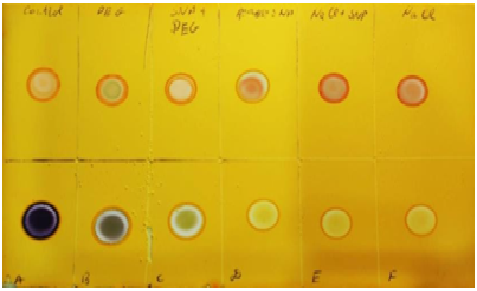
The global population grows, the need for food is also rising significantly. To meet this demand, improving crop resistance to environmental stress is essential, especially for fundamental crops like Triticum durum (durum wheat). Drought and salinity stress are the main limiting factors for crop yield and quality. During drought and salinity stress, plant produces a lot of Reactive Oxygen Species (ROS) which can fight against stress but also can give damage to plant itself. To decrease the effects of ROS, plants produce NO radicals that activate ROS-scavenging enzymes and increase proline, an important amino acid that functions as an osmoregulator during stress. Several studies prove that sodium nitroprusside (SNP) acts as a NO- donor and help to relieve stress. In our research, we focused on how SNP improve proline accumulation in Triticum durum. Our research shows that 0.2 mM SNP improves proline accumulation in Triticum durum under SNP treatment alone. However, in the combined treatments with 3% PEG + 0.2 mM SNP and 100 mM NaCl + 0.2 mM SNP, proline levels under these conditions were not significantly high compared to the SNP treatment alone. This could be explained by additional pathways in proline accumulation.