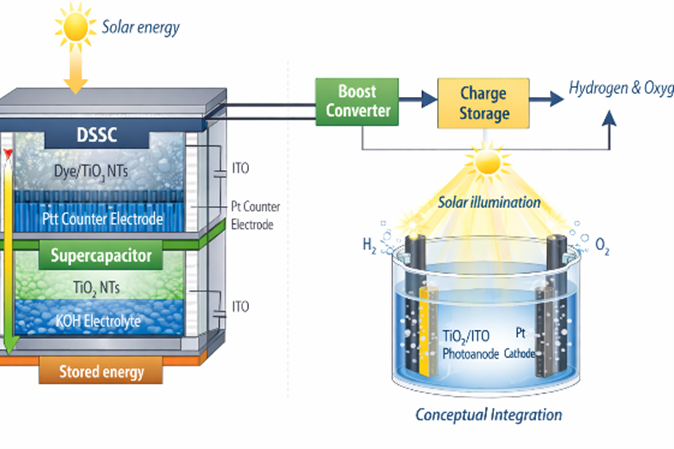
Integrated energy systems that combine solar energy harvesting, storage, and conver-sion into chemical fuels offer a promising pathway toward compact and autonomous renewable technologies. In this work, a transparent, double-sided Glass/ITO/TiO₂ nano-tube (GIT) architecture is developed as a unified materials platform for integrating a dye-sensitized solar cell (DSSC), a supercapacitor , and a photoelectrochemical (PEC) water-splitting unit.
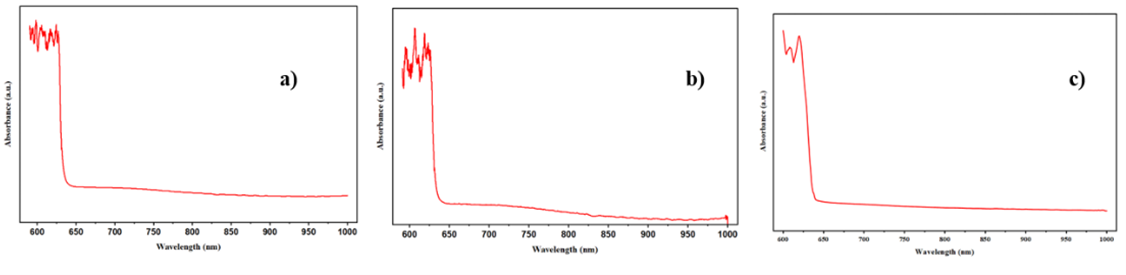
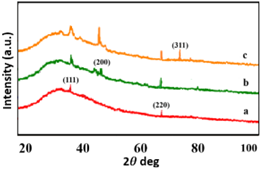
Highly ordered TiO₂ nanotube arrays were fabricated via anodization of magnetron-sputtered Ti films on ITO-coated glass substrates, followed by thermal annealing to obtain the anatase phase and RF nitrogen plasma treatment to tailor surface and elec-tronic properties. Structural and morphological analyses (SEM, Raman spectroscopy and XRD) confirm the formation of vertically aligned crystalline nanotube arrays, while opti-cal measurements reveal high transparency in the visible region.
The architecture incorporates a shared transparent electrode that enables direct cou-pling between energy harvesting and storage components, forming a compact photo-charging configuration. A system-level strategy is introduced to address the intrinsic voltage mismatch between DSSC output and electrochemical processes. PEC measure-ments demonstrate stable photocurrent response and hydrogen evolution under ultra-violet illumination, confirming the intrinsic photoactivity of the TiO₂ nanotube elec-trodes. Although full device-level performance is beyond the scope of this study, the results establish a robust materials and design framework for future integrated solar-to-hydrogen systems.