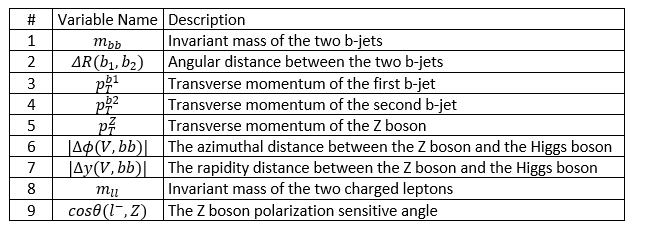
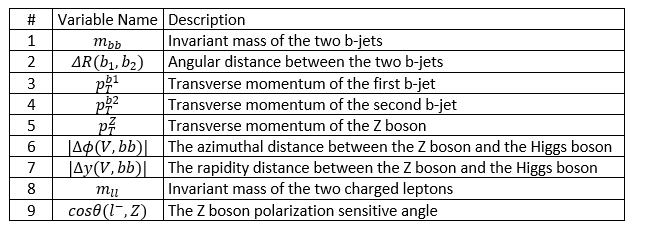
This study evaluates the performance of four machine learning algorithms - Boosted Decision Trees, Artificial Neural Networks, Deep Neural Networks, and Transformers - using Monte Carlo simulated data for the H→bb ̅ Higgs boson decay channel. The dataset comprises approximately 2 million signal events, along with background events from top quark processes, V+jets, and diboson productions. The primary objective is to assess each algorithm’s effectiveness in discriminating the Higgs signal from background processes. Performance metrics such as ROC curve AUC values and significance are employed to provide a comprehensive evaluation of signal/background separation and analysis sensitivity. Results demonstrate that all four machine learning approaches excel in separating signal from background, with ANN exhibiting the highest discrimination power. Hyper-parameter optimization for the Transformer model has not yet been performed; however, given its strong performance with high-dimensional low-level variables, further tuning and the incorporation of additional variables are expected to enhance its performance. The findings highlight the potential of advanced machine learning techniques to improve the accuracy and efficiency of signal/background separation in complex datasets typical of Higgs boson analyses. Overall, the study emphasizes the importance of selecting optimal ML algorithms to maximize experimental sensitivity in high-energy physics research.