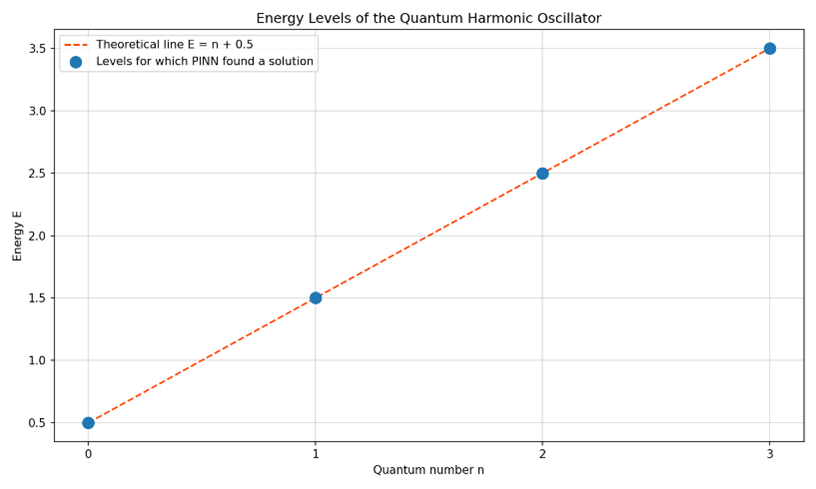
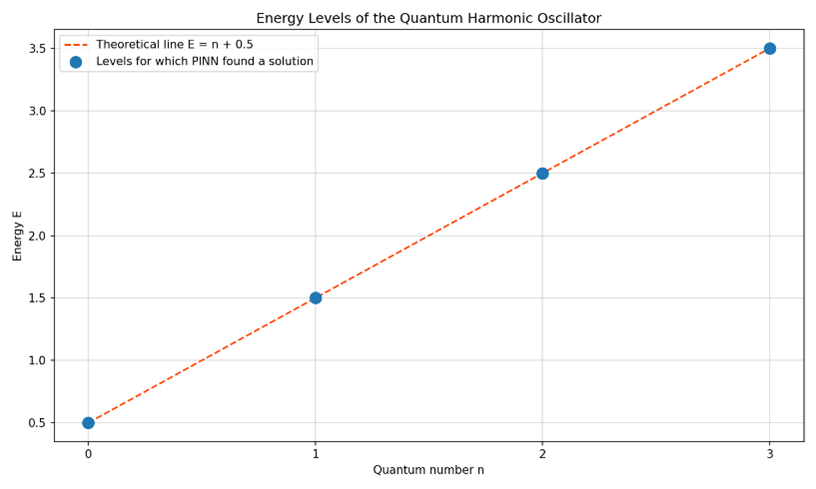
This paper demonstrates the versatility and accuracy of Physics-Informed Neural Networks (PINNs) for solving eigenvalue problems in quantum mechanics. We apply the PINN methodology to two cornerstone systems with fundamentally different potentials: the one-dimensional quantum harmonic oscillator (QHO) with a smooth parabolic potential, and the hydrogen atom with its singular Coulomb potential. The PINN approach approximates the wavefunction using a neural network trained to satisfy the time-independent Schrödinger equation and its physical constraints (boundary conditions and normalization) without spatial discretization. The results show that for both systems, the PINN accurately computes the wavefunctions for the ground and several excited states. The energy levels obtained for the QHO perfectly match the linear relationship E_n∝n+1/2, while those for the hydrogen atom precisely follow the hyperbolic curve E_n∝-1/n^2. This dual success validates PINN as a powerful, flexible, and grid-free tool capable of handling both smooth and singular potentials in quantum mechanics.