BAKU STATE UNIVERSITY JOURNAL of
PHYSICS & SPACE SCIENCES
ISSN: 3006-6123 (ONLINE);
Machine learning in physics and semiconductor materials: approaches to modeling and prediction
Received: 29-Dec-2025 Accepted: 12-Feb-2026 Published: 16-Mar-2026 Read PDFDownload PDF
Vusala J. Mammadova
DOI:
Abstract
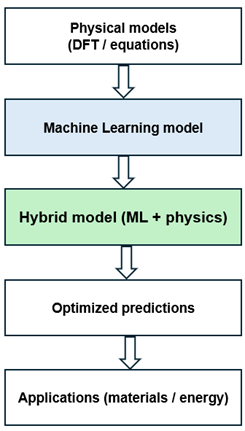
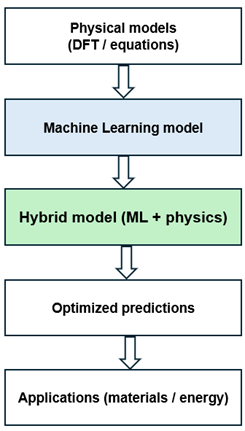
Machine learning (ML) has recently emerged as a powerful complement to traditional theoretical and computational methods in physics and materials science. It enables faster and more efficient predictions of physical properties compared to resource-intensive approaches such as Density Functional Theory (DFT). In this work, ML applica-tions in physical systems are systematically analyzed within a unified conceptual framework encompassing surrogate models, physics-informed approaches, and hybrid methods. Attention is given to semiconductor materials, where ML significantly acceler-ates the prediction of energy gaps and optical properties based on composition and structural parameters. Overall, the integration of ML with physics enhances modeling flexibility and provides new opportunities for data-driven materials design.