BAKU STATE UNIVERSITY JOURNAL of
EARTH SCIENCES & ENVIRONMENT
ISSN: 3006-8703 (ONLINE);
INTEGRATED GEOPHYSICAL APPROACH VIA JOINT INVERSION OF LONG-OFFSET AND CENTRALLOOP TEM DATA: CASE STUDY FROM THE PEREKISHKUL, AZER-BAIJAN
Received: 05-May-2025 Accepted: 12-Sep-2025 Published: 21-Sep-2025 Read PDFDownload PDF
Avaz L. Mammadov; Ali G. Novruzov; Vagif G. Gadirov
DOI:
Abstract
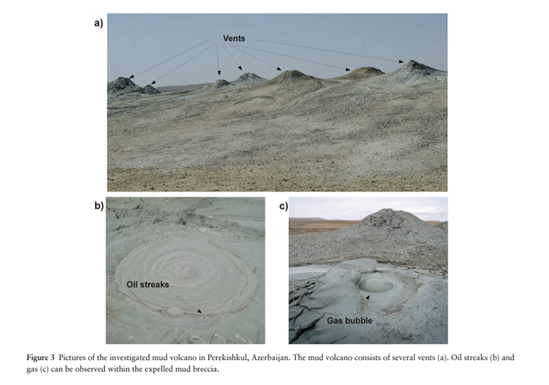
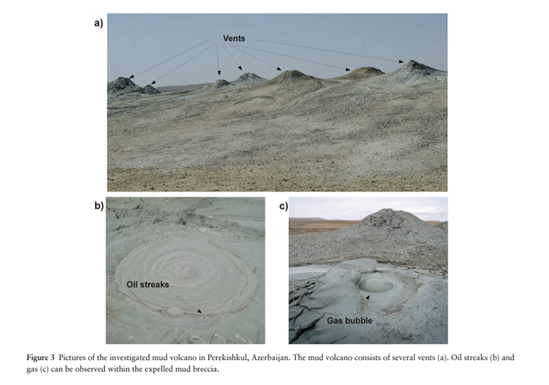
Mud volcanism is commonly observed in Azerbaijan and the surrounding South Caspian Basin. This natural phenomenon is very similar to magmatic volcanoes but differs in one considerable aspect: Magmatic volcanoes are generally the result of ascending molten rock within the Earth’s crust, whereas mud volcanoes are characterized by expelling mixtures of water, mud, and gas. The majority of mud vol-canoes have been observed on ocean floors or in deep sedimentary basins, such as those found in Azer-baijan. Furthermore, their occurrences in Azerbaijan are generally closely associated with hydrocarbon reservoirs and are therefore of immense economic and geological interest. The broadside long-offset transient electromagnetic method and the central-loop transient electromagnetic method were applied to study the inner structure of such mud volcanoes and to determine the depth of a resistive geological formation that is predicted to contain the majority of the hydrocarbon reservoirs in the survey area. One-dimensional joint inversion of central-loop and long-offset transient electromagnetic data was per-formed using the inversion schemes of Occam and Marquardt. By using the joint inversion models, a sub-surface resistivity structure ranging from the surface to a depth of approximately 7 km was determined. Along a profile running perpendicular to the assumed strike direction, lateral resistivity variations could only be determined in the shallow depth range using the transient electromagnetic data. An attempt to resolve further two-dimensional/three-dimensional resistivity structures, representing possible mud mi-gration paths at large depths using the long-offset transient electromagnetic data, failed. Moreover, the joint inversion models led to ambiguous results regarding the depth and resistivity of the hydrocarbon target formation due to poor resolution at great depths (> 5 km). Thus, 1D/2D modelling studies were subsequently performed to investigate the influence of the resistive terminating half-space on the measured long-offset transient electromagnetic data.