Ümit D. Göker; Ukte Aksen
DOI:
Abstract
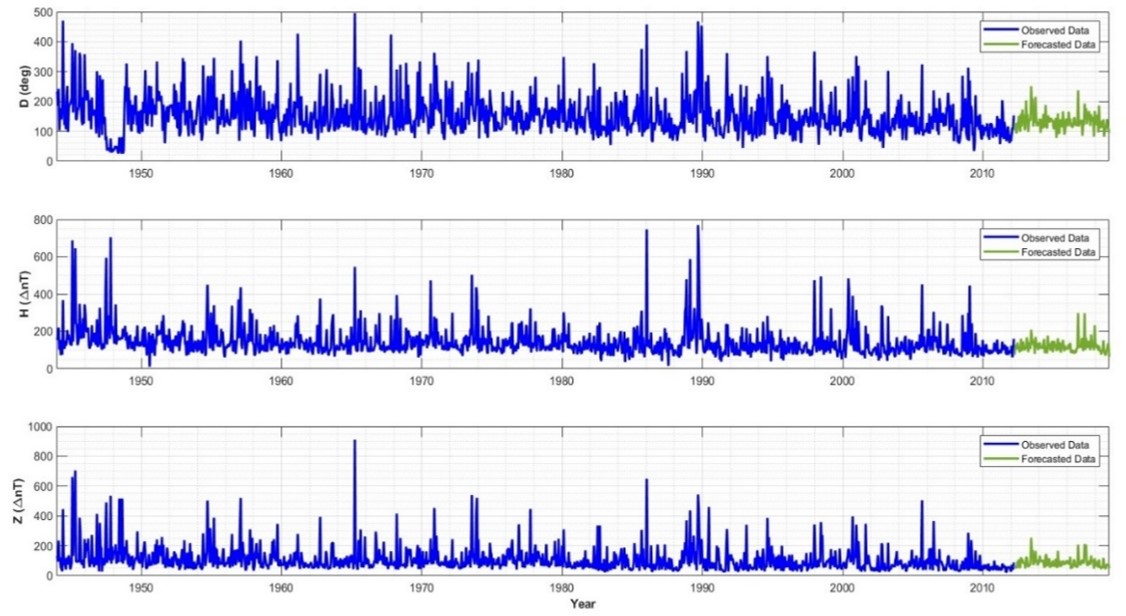
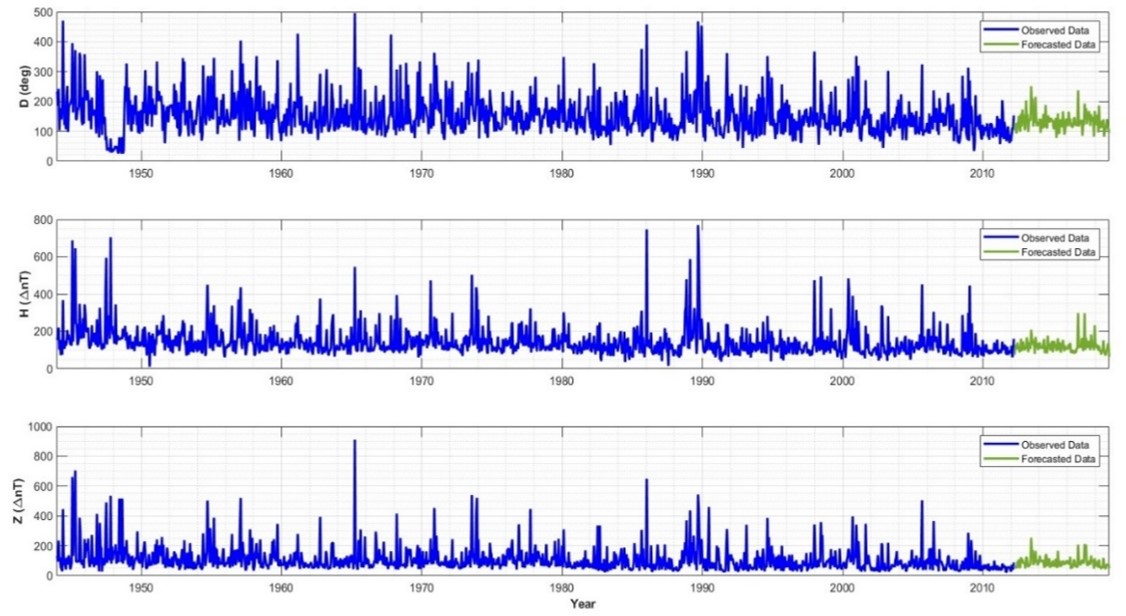
This paper extends the analysis of the relationship between geomagnetic storms (GSs) and aircraft accidents, seasonal variations, solar activity (SA), and geomagnetic activity (GA) by investigating the effects of solar wind (SW) parameters on the Earth’s atmos-phere and the components of the Earth’s magnetic field (MF), including the D, H, and Z components, across latitudes between ±10° and ±90° in solar activity cycles (SACs) 18–24. All analyses and visualizations were performed in MATLAB R2018a, and missing data were imputed using an ARIMA forecasting model. The results indicate that aircraft acci-dents predominantly occurred during the decreasing phases of solar cycles (SCs), except for SAC 24. Accident frequencies were highest around equinox periods, particularly in March, September, and early October, and lowest during the solstices in June and De-cember. During the decreasing phase of SC 19, fewer accidents occurred than in SC 18 despite stronger MF fluctuations, whereas SC 20 exhibited stable MF behavior with a higher number of accidents. Significant increases and fluctuations in MF components during the decreasing phases of SCs 22 and 23 were directly proportional to accident numbers, while SAC 24 showed minimal variability. SW parameters also varied across cycles, with plasma velocity, pressure, temperature, and beta values showing cycle-dependent behavior. The Bz-component exerted the strongest influence on Earth, while the Hn parameter after SC 21 dominated magnetospheric variations. Overall, the find-ings suggest that GSs alone cannot explain aircraft accidents; instead, their effects are amplified or weakened by temporal changes in the Earth’s magnetic field, making them more influential during specific seasons and phases of SA.